
RoboticsExplainer
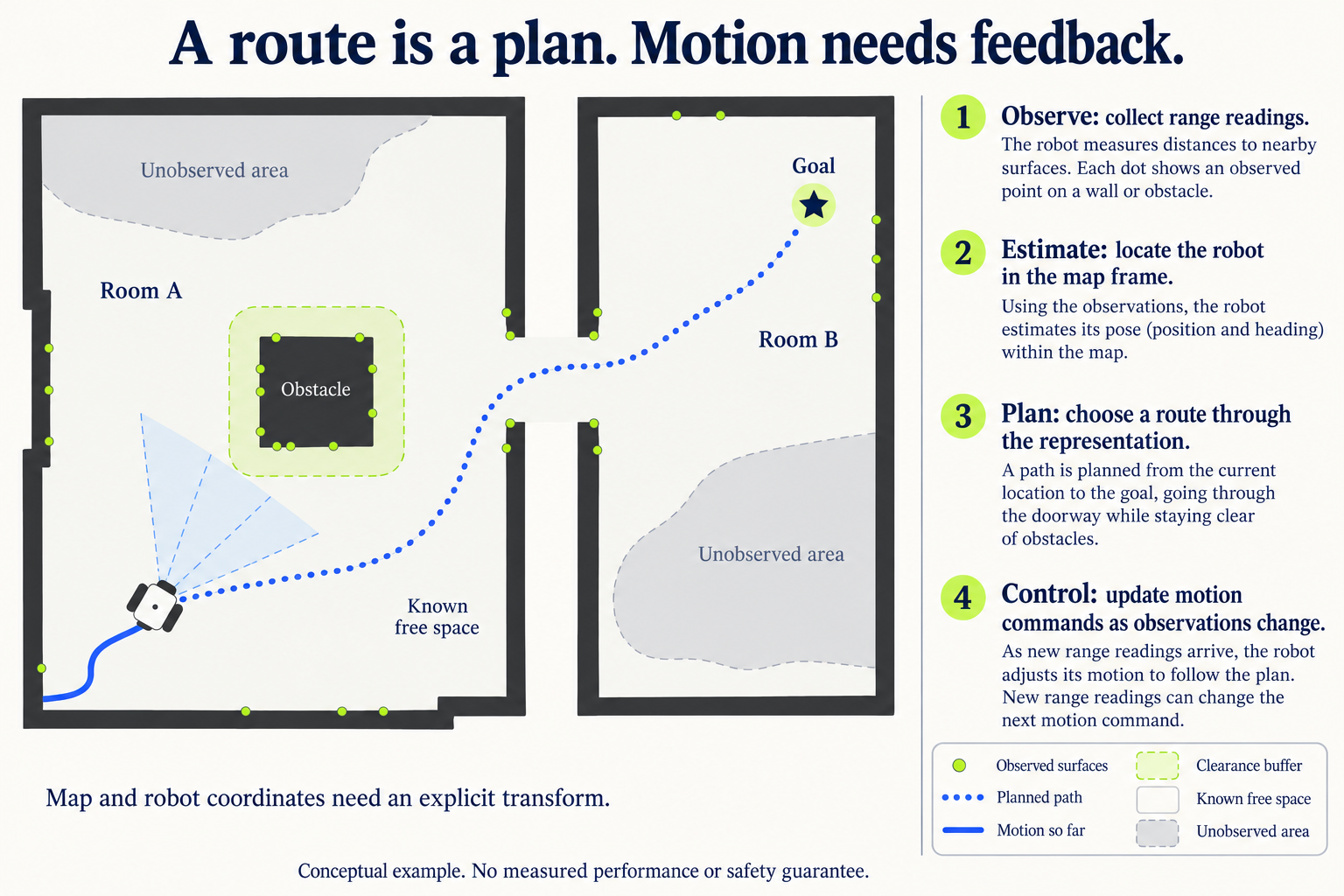
How a robot turns sensor readings into movement.
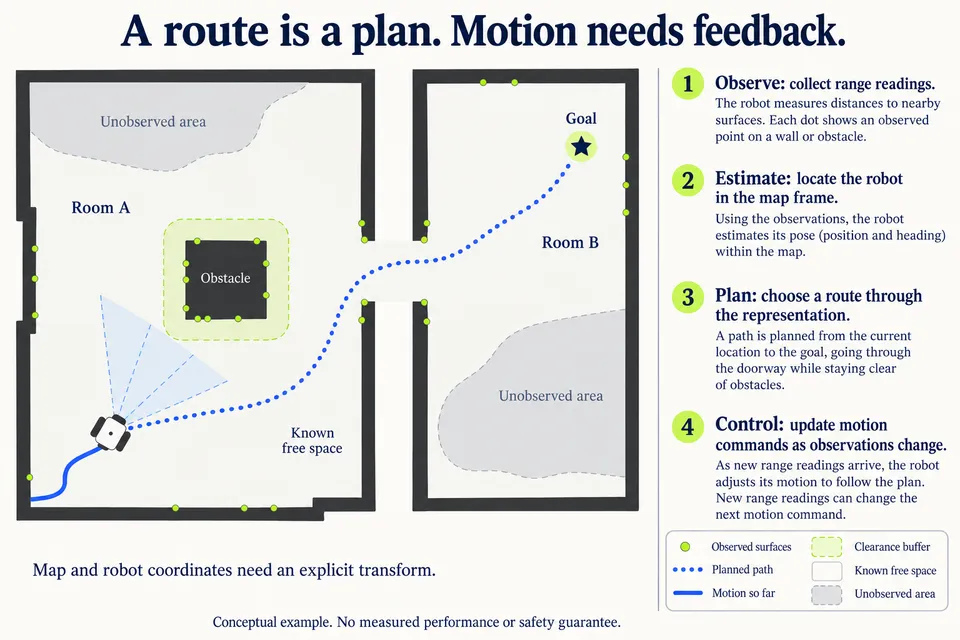
Follow the loop from sensing and localization to planning and control, and learn why timing and coordinate frames matter as much as a good-looking route.
Clear explanations, real examples, and the evidence behind new ideas.
Follow the loop from sensing and localization to planning and control, and learn why timing and coordinate frames matter as much as a good-looking route.
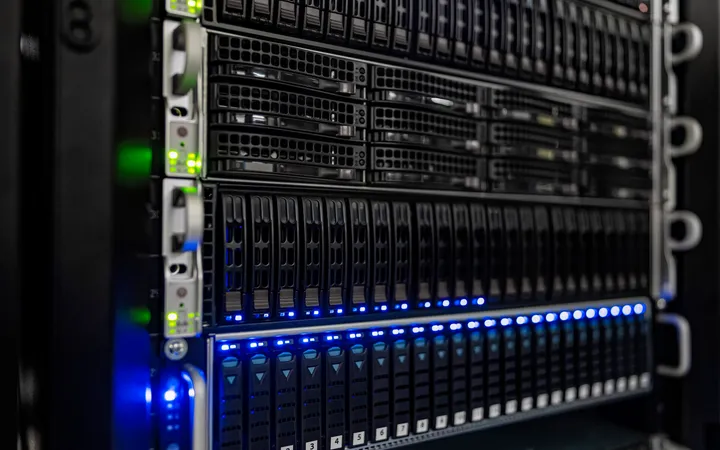
Understand retrieval-augmented generation, embeddings and citations with a worked example—and see why finding a source is not the same as proving an answer.
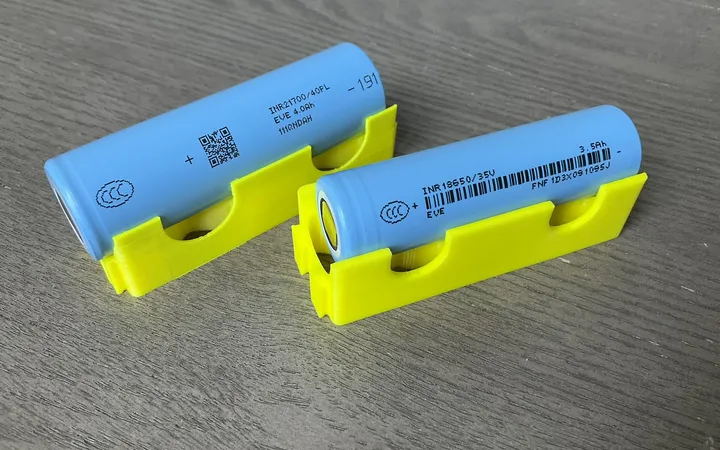
Learn what happens inside a rechargeable cell, how amp-hours differ from watt-hours, and how to read a battery headline without mixing material and pack results.
A doorway, a map and a moving obstacle reveal why sensing, localization, planning and control have different jobs.
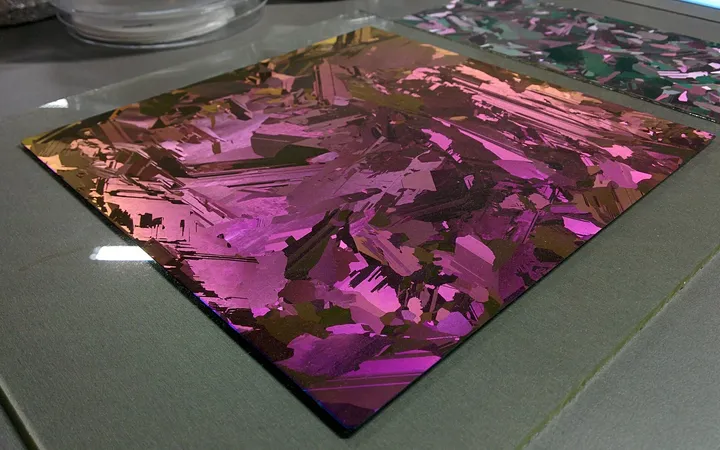
A clear guide to silicon photonics: light sources, modulators, waveguides and detectors, and why an optical link is not the same as an all-optical computer.
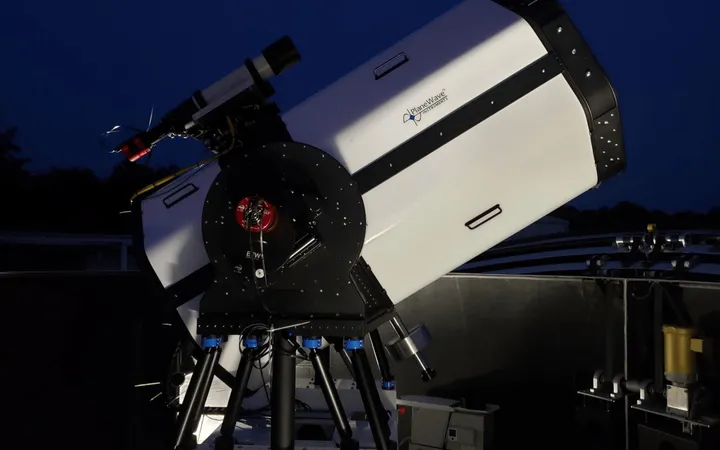
Learn how optical communications encode and receive data, why precise pointing and weather matter, and how data rate differs from communication delay.
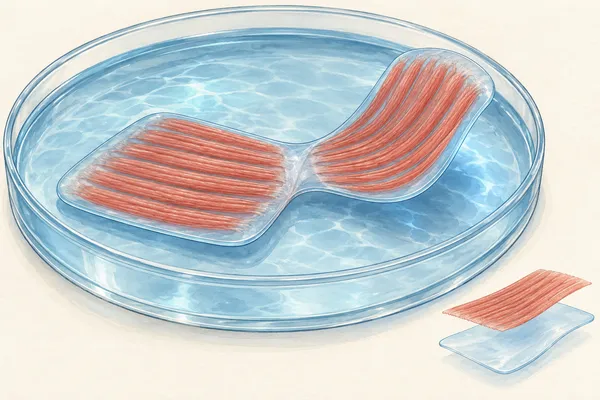
Understand biohybrid actuators, the role of a mechanical skeleton, and the difference between a light-controlled laboratory swimmer and an autonomous robot.
Read a concept, follow its research story, then ask where the evidence ends.
Use the diagram and example to understand what the technology actually does.
Each explainer links to a related research brief with the original source and date.
Check the measurement, conditions and missing evidence before extending a claim.
A workflow that retrieves relevant information and supplies it as context for a generated answer. The retrieved evidence and the answer still need checking.
Read the explanation →A numerical representation used to compare information, often by semantic similarity. Similarity is a retrieval signal, not proof that a statement is true.
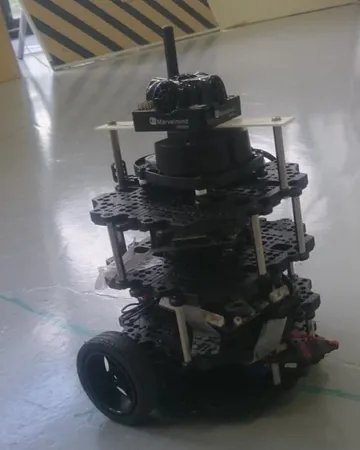
Read the explanation →Estimating where a robot is within a reference frame or map. It differs from simply measuring recent movement.
Read the explanation →A representation used by a navigation system to assign movement costs to regions. Its values describe the model, not every possible real-world hazard.
Read the explanation →A unit of energy. A watt is a unit of power: the rate of using or supplying energy. Keeping them separate makes battery comparisons clearer.
Read the explanation →A structure that confines and directs a wave. In a photonic chip, it helps guide light through the optical circuit.
Read the explanation →Data rate describes how much information can be carried per unit time. Latency describes delay; increasing the rate does not eliminate propagation time.
Read the explanation →An engineered mechanism in which living cells contribute force or motion. Tissue, structure, stimulus and support conditions are all part of the system.
Read the explanation →Explore the source-linked briefs, or use a free calculator to make your own assumptions visible.