Start with the two paths
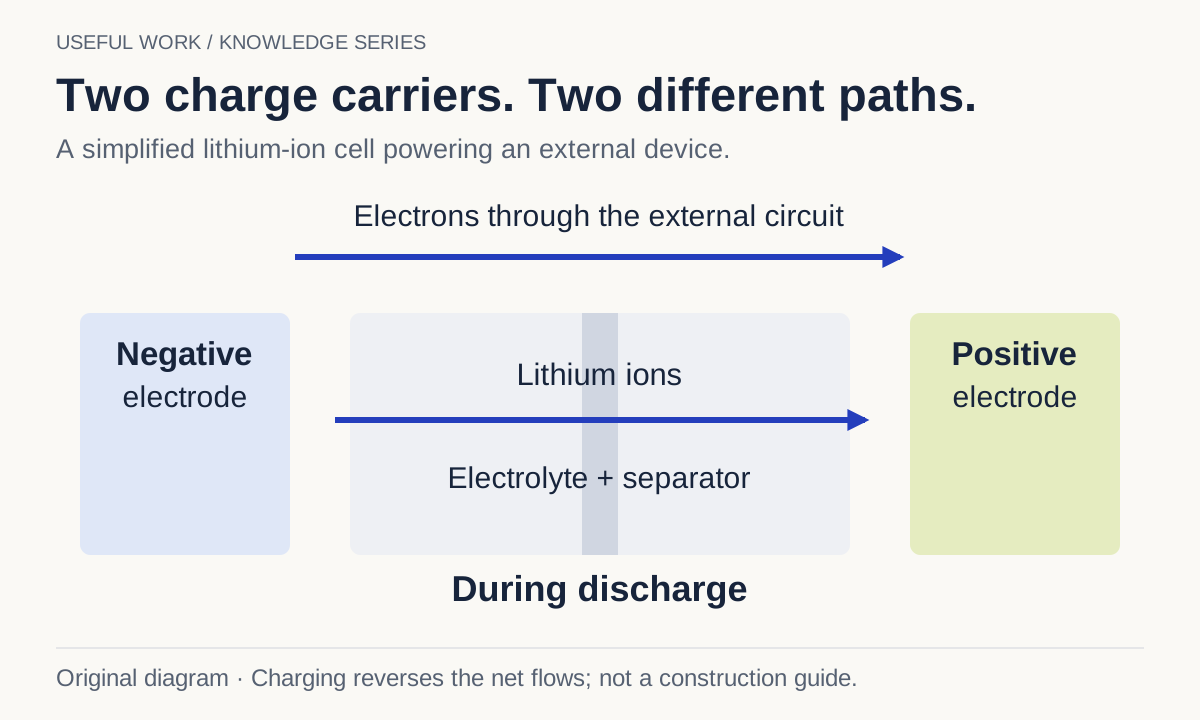
A rechargeable battery stores energy through a change in chemical potential. When it powers a device, chemical processes support the movement of charge. Electrons travel through the external circuit; ions move through the electrolyte inside the cell. Both paths belong to the explanation.
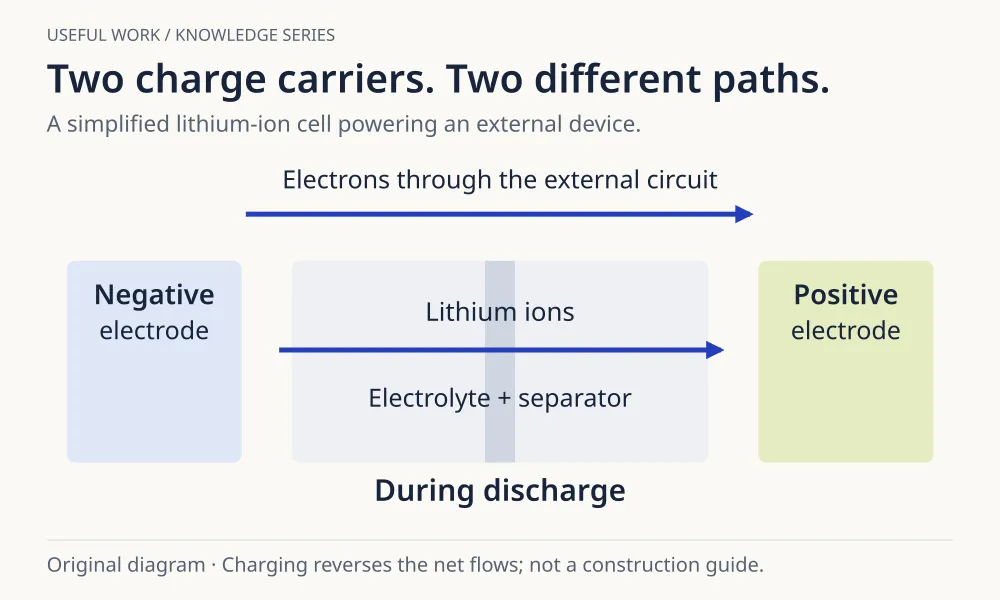
In a simplified lithium-ion cell during discharge, lithium ions move from the negative electrode toward the positive electrode through the electrolyte. Electrons reach the other electrode through the connected circuit. Charging drives the system in the opposite net direction. The diagram describes the principle, not the construction of a particular cell.
Ask what the number measures
Capacity, often expressed in amp-hours, describes an amount of electric charge under specified conditions. It does not tell the whole energy story because voltage also matters.
Energy, often expressed in watt-hours, describes an amount of energy. For a simple nominal estimate, multiply amp-hours by nominal voltage. Power, expressed in watts, is the rate at which energy is supplied or used.
This distinction prevents a common comparison error. Two packs with the same amp-hour figure can have different energy ratings if their voltages differ. Even matching energy ratings do not establish identical size, usable output or lifetime.
Try an illustrative calculation
Take a fictional battery rated at 3.6 volts and 5 amp-hours. Its nominal energy estimate is 3.6 × 5 = 18 watt-hours. If a fictional device drew a constant 6 watts and every nominal watt-hour were available, the arithmetic would give 18 ÷ 6 = 3 hours.
That result explains the units; it does not predict an actual product’s runtime. Conversion losses, changing load, operating temperature, battery condition and the device’s cutoff behavior can change what is usable. A measured runtime test needs those conditions, not just a capacity label.
Separate material, cell and pack
A material experiment can reveal how an electrolyte behaves. A complete cell adds electrodes, interfaces and practical operating conditions. A pack adds multiple cells, connections and supporting systems. Improving one measurement at one level does not automatically establish the same improvement at every other level.
The solid-state battery research brief is an example: the reported work examines a material’s internal boundaries. Its relevance is a more specific understanding of a failure mechanism, not a promise that every future pack will charge faster or last longer.
A checklist for the next headline
Identify the metric first. Is the claim about energy per mass, charging rate, cycle life, a particular material or a finished product? Then look for temperature, test duration, comparison baseline and whether the result was repeated at a relevant scale.
When a report leaves one of those details out, keep that gap visible. You can recognize a useful scientific result without turning it into a purchasing prediction or a claim about a battery that has not been built.
Change the numbers. Keep the meanings separate.
This fictional example separates charge capacity (Ah), nominal energy (Wh) and power (W). It does not describe the photographed cells or predict actual runtime.
Nominal voltage × Ah = Wh. Wh ÷ W = hours. Losses, temperature, changing load and cutoff conditions change real results.
See the simple overview
Keep the evidence in view.
The arithmetic uses an idealized example. It is not a runtime guarantee, charging procedure or specification for building a battery.
Technical sources checked: . Our source check: . This is an AI-assisted editorial explanation, not an independently reproduced experiment.
Sources & further reading
- US Department of EnergyDOE Explains...Batteries
- US Department of Energy, October 2012Lithium-Ion Batteries for Stationary Energy Storage
- MIT NewsDiscovery helps explain why solid-state batteries often fail