Give the word actuator a job
An actuator turns an input into mechanical action. A familiar motor can rotate a shaft. In a biohybrid actuator, living cells supply part of the force-producing mechanism and an engineered structure helps turn that force into motion.
“Biohybrid” is therefore a description of a combination. It does not mean the complete device is a living organism, and it does not establish what the machine can sense or decide on its own.
Muscle force needs somewhere to go
A contracting muscle can pull, but the surrounding structure changes the resulting motion. MIT’s 2024 work on flexible skeletons explored this relationship using spring-like structures called flexures. Their compliance helps guide the direction in which an attached muscle can move the structure.
That distinction is easy to miss in an image of the tissue. The biological component and the mechanical component form a system. A stronger contraction does not automatically become a more useful movement if the geometry sends force in an unhelpful direction.
Think of pulling on a loose ribbon and pulling on a carefully guided linkage. The same act of pulling can produce very different motions. This is an analogy for the design question, not a measurement of the research device.
Read the illustration from tissue to movement
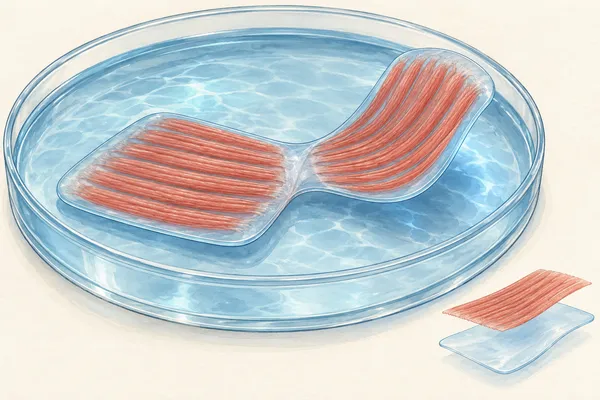
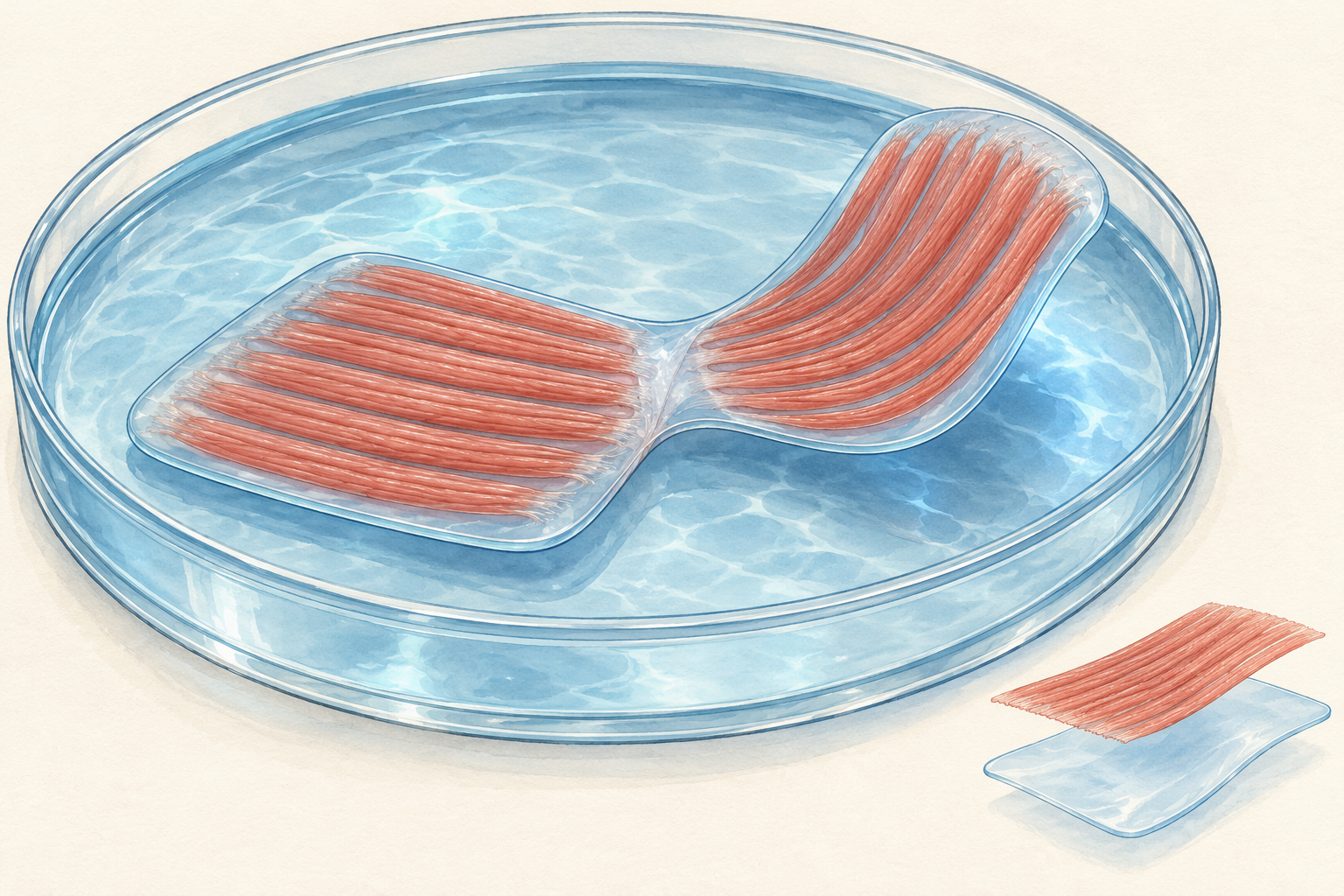
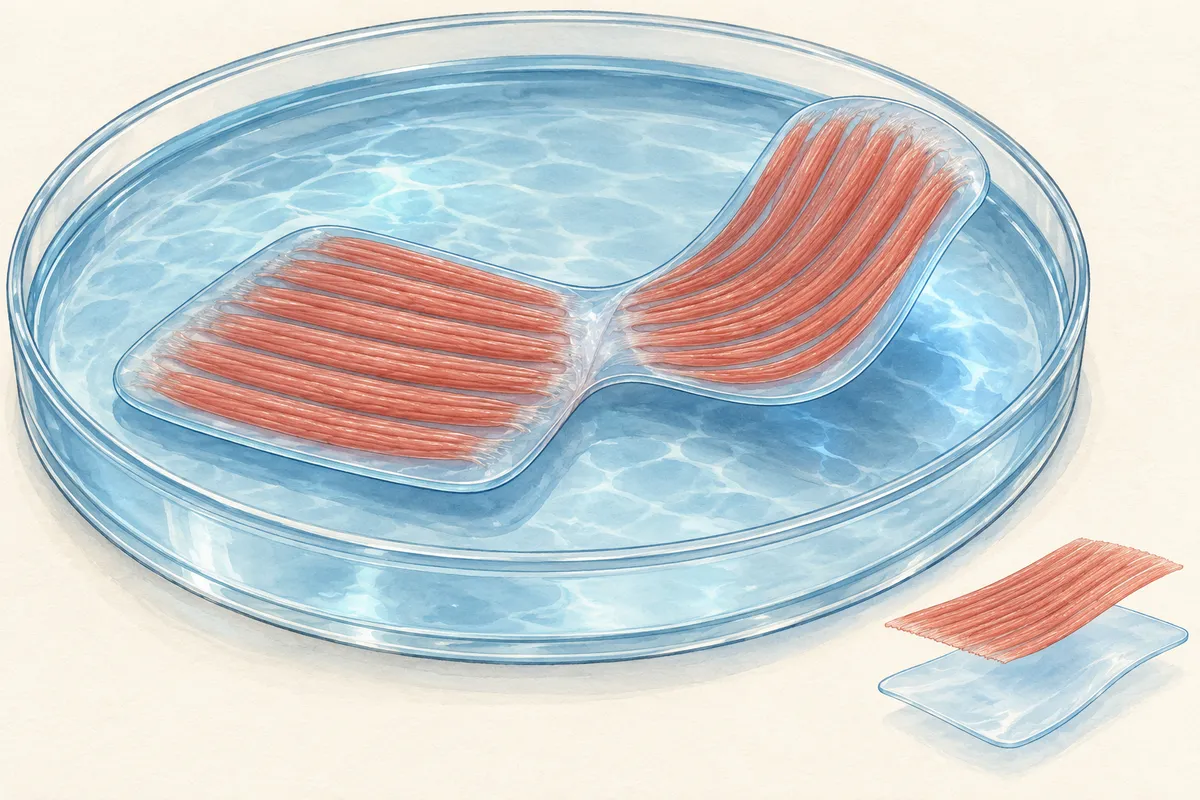
The coral lines represent aligned muscle fibers. The translucent blue layer represents a flexible support. The separated detail makes the layers visible; it does not show a fabrication process or a microscopy image.
- Attach the pull to a structure. Tissue that shortens needs a mechanical connection to the part it will move.
- Let the structure deform. A flexible support can turn a surface contraction into bending. Geometry and stiffness affect that response.
- Interact with the surroundings. A fin moving in fluid can generate a force on the device. Bending alone does not tell us its net swimming speed.
- Keep the tissue supported. The surrounding laboratory environment belongs in the system description alongside the visible moving parts.
This is a general mechanism, not an exact drawing of either MIT experiment. The illustration deliberately leaves out electronics: the muscle is the actuator; a glowing component inside the body would misleadingly suggest an onboard control system.
Separate stimulus from autonomy
In the 2026 swimming-robot report, engineered muscle cells responded to light. The researchers used the response to make fins flap and steer a small device through a laboratory maze. A visible swimming motion establishes something about actuation under those conditions.
It does not, by itself, establish onboard sensing, independent navigation or long-term operation in an uncontrolled environment. Those are additional system capabilities with their own evidence requirements. Calling a device a robot should not hide which parts of the behavior were supplied by the experimenter.
Compare the engineering questions
| Design question | What to look for |
|---|---|
| Does the tissue generate force? | A force measurement and its stimulation conditions. |
| Does the structure use that force? | Deflection, work or a repeatable movement of the assembled device. |
| Does the machine navigate independently? | Evidence of sensing, decisions and control without the experimenter supplying the route. |
A video can answer the movement question while leaving the navigation question open. That is a useful result to describe precisely, without asking a single experiment to prove every future capability.
Read the whole experimental setup
For a biological actuator, ask about the tissue, how it is attached, the stimulus and the support environment. Then ask what was measured: force, displacement, speed, endurance or another outcome. Those measurements answer different questions.
The Raman Lab describes biological-actuator research as an engineering effort spanning tissue design and robotic applications. That context helps explain why a paper may focus on one mechanism without presenting a ready-to-use product.
A practical way to read the next result
Use three columns in your notes: demonstrated, proposed, and not established. Put the measured behavior and its conditions in the first column. Put possible future applications in the second. Keep unanswered questions in the third.
Try that method on our muscle-powered swimmer brief. It lets you appreciate the result while keeping a laboratory mechanism separate from a future environmental tool, autonomous system or clinical use.
Keep the evidence in view.
This is an explanation of reported research mechanisms, not a cell-culture protocol, medical recommendation or demonstration of autonomous field operation.
Technical sources checked: . Our source check: . This is an AI-assisted editorial explanation, not an independently reproduced experiment.
Sources & further reading
- MIT News, April 2024MIT engineers design flexible skeletons for muscle-powered robots
- MIT News, September 2026Powered by muscle cells, a paper-thin robot swims through watery maze
- Raman Lab, MIT Mechanical EngineeringBiological actuators and soft robotics research