Start with a familiar problem
Imagine asking an assistant which version of a project’s setup guide applies to your laptop. A language model may know how similar software usually works, but that does not mean it has your project’s current instructions. Retrieval-augmented generation, or RAG, adds a way to look up relevant material before composing an answer.
The important separation is between the model’s learned patterns and the information supplied for this particular question. RAG can add current documents to the context without retraining the model for every document change.
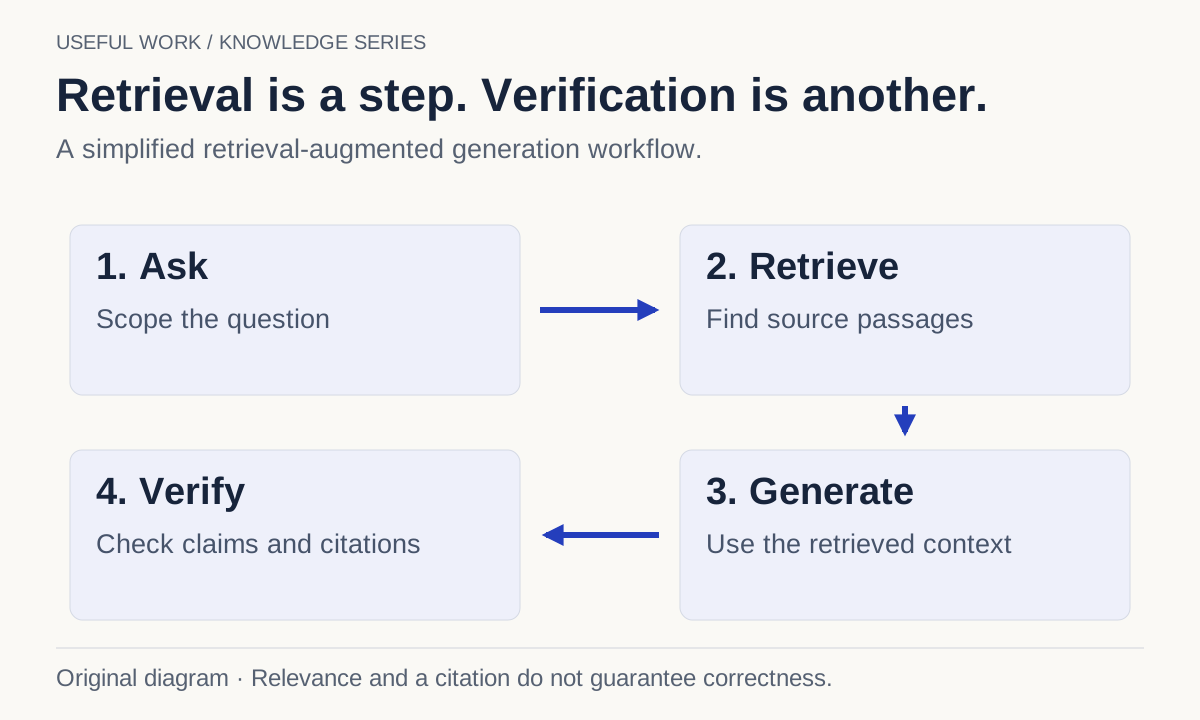
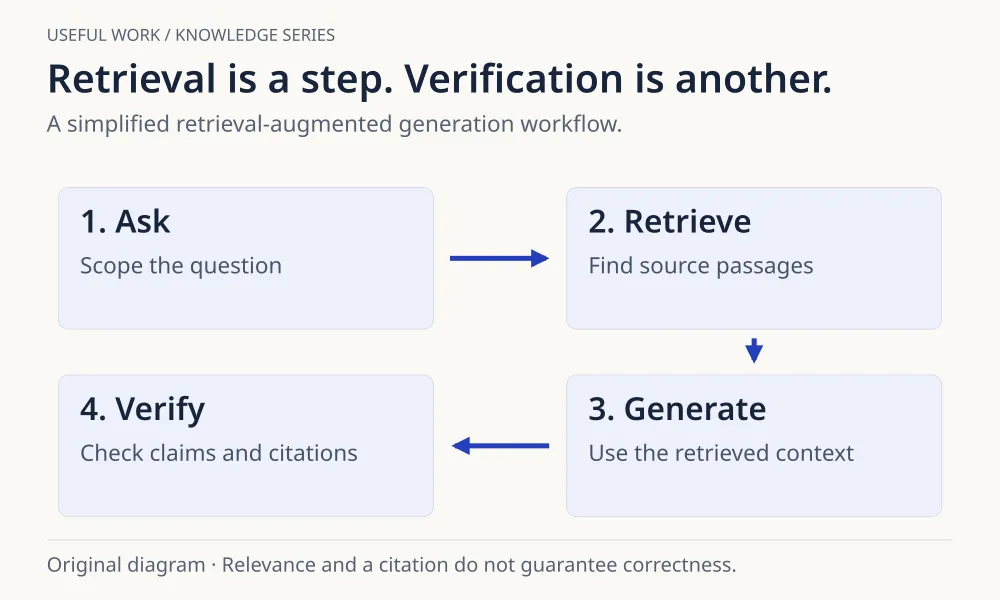
Follow the four stages
First, prepare the material. A system extracts text, divides it into useful passages and preserves references to the original documents. An embedding is a numerical representation that can help a search system compare meaning. A vector index stores representations for retrieval; it is not a truth database.
Second, retrieve candidates. The system searches for passages relevant to the question. Some implementations combine keyword and vector search. Finding similar language is useful, but similarity alone does not establish that a passage answers the question or belongs to the right version.
Third, generate with context. Selected passages accompany the user’s question. The model uses that context to produce an answer. Retrieval quality and answer quality are related, but they are different things to inspect.
Fourth, verify the result. Check whether the cited passage actually supports the statement, whether it is current, and whether the answer stays within the evidence.
Work through a fictional example
Suppose a project has an old guide that says “use port 3000” and a newer guide that says “use port 4321.” The question is, “Which port should I use for version B?” A search could retrieve both pages because both discuss local development.
A better answer needs the version relationship, not simply the highest similarity score. It should identify the version-B guide, cite the relevant passage and explain any missing information. If neither document identifies version B, an explicit “the documents do not establish this” is more useful than a confident guess.
This example illustrates an evaluation question you can reuse: did the system find the right evidence, and did the answer follow it?
Know what RAG does not solve
Retrieval does not grant permission to reveal a document. Access control must apply before private material reaches the model or reader. A source may also contain outdated facts, contradictory instructions or hostile text. Retrieved material should be treated as evidence to examine, not as authority to change the application’s rules.
For a small evaluation, collect questions with known supporting passages, questions with conflicting versions, and questions the documents cannot answer. Inspect retrieval and generated answers separately. That gives you a more useful picture than judging the system only by fluent prose.
Connect it to the news
The same reading habit helps assess AI research announcements: identify the task, inspect the evidence, and ask what happens outside the demonstrated conditions. RAG is one technique for providing context, not a substitute for those questions.
Finding a passage is only half the job.
Question: which development port should version B use? These two toy documents are invented to show why version evidence matters.
Guide for version A
“Use port 3000.”
Relevant words; a different version.
Guide for version B
“Use port 4321.”
The passage supports the answer only when its version is known.
The newer guide is useful because it identifies version B, not simply because its words are similar to the question.
A deterministic illustration. No model is running and no live documents are searched.
See the simple overview
Keep the evidence in view.
This is a conceptual workflow with a fictional example, not a benchmark or a claim that a particular vendor prevents hallucinations.
Technical sources checked: . Our source check: . This is an AI-assisted editorial explanation, not an independently reproduced experiment.
Sources & further reading
- AWS documentationHow Amazon Bedrock knowledge bases work
- AWS documentationRetrieve data and generate AI responses with Knowledge Bases
- AWS Prescriptive GuidanceGrounding and Retrieval Augmented Generation